-
 By: Janina Criador
 - IT Guides
- Last Updated On: April 18, 2026
- Comments 0
- ⏱️7 min read

Azure AI vs. Copilot: Why Your 2026 Strategy Needs ‘Agentic’ Workflows
In 2026, the question is no longer “Should we use AI?” but “Is our AI autonomous?” The shift from generative assistance to agentic workflows has created a sharp divide between companies that simply use AI and those that are powered by it. At the core of this change are two major players: Microsoft Copilot and Azure AI (now focused on Azure AI Foundry).
Both sit within the Microsoft ecosystem. They serve fundamentally different purposes. Copilot is your “out-of-the-box” productivity partner, while Azure AI is the “under-the-hood” engine for custom-built innovation. To dominate your market in 2026, you must understand where the line is drawn.

TLDR: Navigating the AI Shift
- Autonomy is the new standard for business efficiency. The 2026 landscape has shifted from simple generative assistance to “agentic” workflows. Companies must choose between ready-made tools and autonomous systems to stay competitive.
- Copilot is for individual productivity, while Azure AI is for custom innovation. Copilot serves as an out-of-the-box partner for M365 tasks. Azure AI Foundry provides the “under-the-hood” engine for developers to build independent agents and complex multi-step processes.
- Strategic needs dictate your platform choice. Use Copilot for rapid ROI in security and general office work. Choose Azure AI for high-compliance environments, customer-facing products, or logic that spans beyond the Microsoft ecosystem.
What Is the Difference Between Copilot and Azure AI in 2026?
The core difference lies in autonomy versus assistance.
- Microsoft Copilot
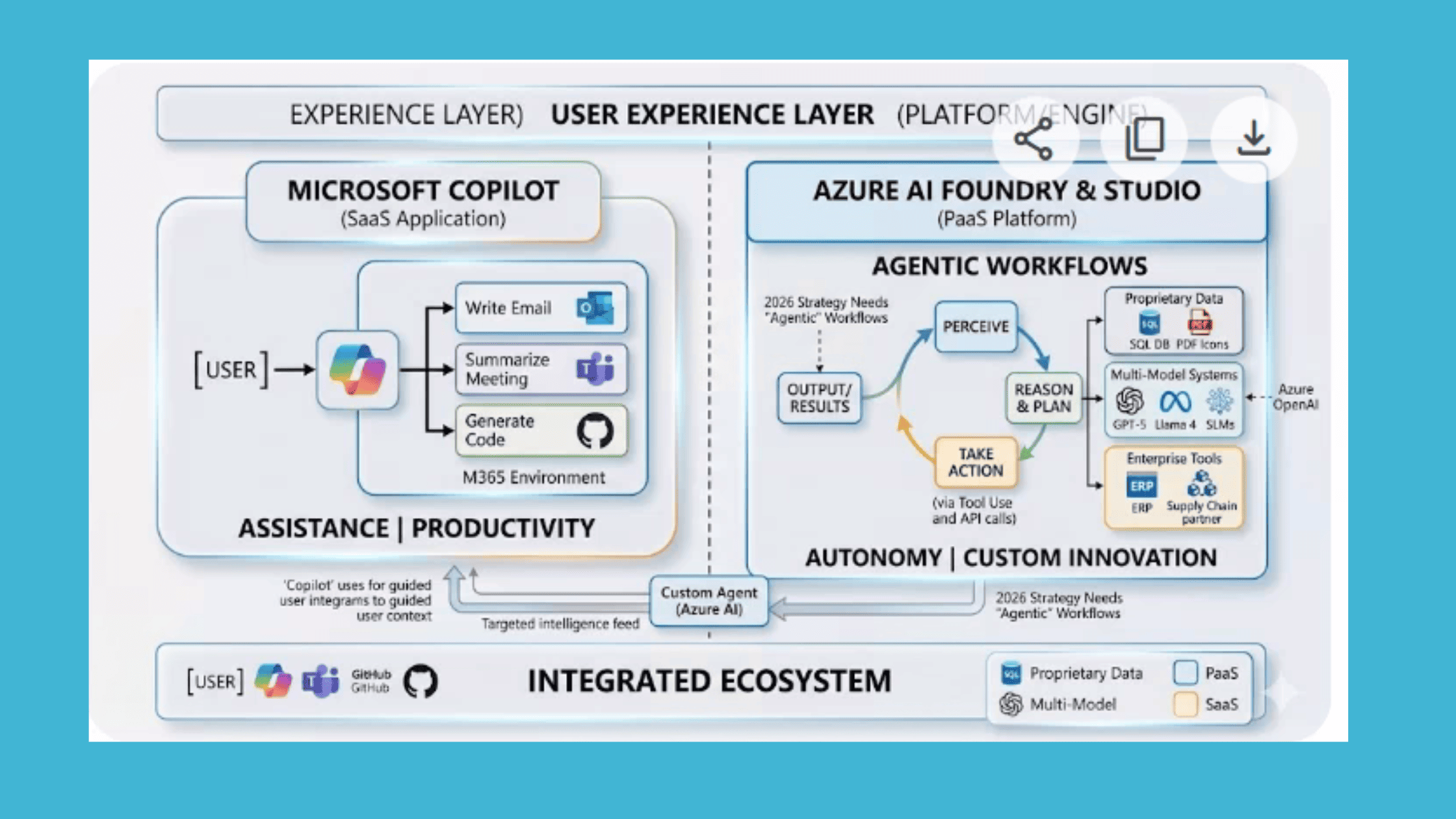
is a Software-as-a-Service (SaaS) application. It is designed for immediate consumption, helping users write emails, summarize meetings, and generate code within the
M365 environment.
- Azure AI
(specifically Azure AI Foundry and Studio) is a Platform-as-a-Service (PaaS). It is a suite of tools that developers use to build, deploy, and manage their own custom AI models and “Agents.” They are independent entities that can execute multi-step business processes without human intervention.
A simple way to think about it is this: Copilot helps people work faster, while Azure AI helps companies build smarter systems. Taking advantage of AI now is not asking AI questions. It is about orchestrating AI to take action across tools, approvals, and data sources.
How does Copilot compare with Azure OpenAI?
Microsoft Copilot is the experience layer. Azure OpenAI is the model foundation that can power custom AI solutions.
A useful way to think about it is:
- Use Copilot when you want a ready-made productivity experience.
- Use Azure OpenAI when you need model access inside a custom solution.
- Use Azure AI Foundry when you need to design, connect, and deploy the full workflow.
That is why the real comparison is often not Copilot vs Azure OpenAI alone. It is whether you need packaged productivity or full custom orchestration.
Should You Buy Microsoft Copilot for Security in 2026?
Microsoft Copilot for Security in 2026 fits best where security teams need speed, investigation support, and guided action inside existing Microsoft security workflows. It is strongest when used as a frontline assistant for analysts who need rapid context, summarization, and response support.
- Why buy it? It reduces the “Mean Time to Respond” (MTTR) by translating complex script analysis and threat telemetry into natural language. In 2026, where “AI-on-AI” cyber warfare is common, Copilot for Security acts as a junior analyst that never sleeps.
- The Verdict: If your SOC (Security Operations Center) is overwhelmed by alert fatigue, Copilot for Security is a high-ROI purchase. However, if you require a security tool that can automatically rewrite your firewall rules based on custom proprietary protocols, you would need to build a custom agent via Azure AI.
Don’t leave your Microsoft E5 data untapped. While Copilot for Security is billed separately via Azure, it is designed to supercharge your existing E5 investment by slashing MTTR (Mean Time to Respond).
How Does Azure AI Foundry Power Agentic Workflows for B2B?
The buzzword of 2026 is “Agentic AI.” Unlike a standard chatbot that waits for a prompt, an agentic workflow allows an AI to perceive an environment, reason through a goal, and take action.
- Azure AI Foundry is the primary environment for deploying these workflows. It allows B2B companies to:
- Orchestrate Multi-Model Systems: Using GPT-5 (or the latest iteration), Llama 4, and specialized SLMs (Small Language Models) simultaneously.
- RAG (Retrieval-Augmented Generation): Connecting AI to your live SQL databases or proprietary PDFs so the AI knows your specific business logic.
- Tool Use: Giving the AI “hands” to click buttons in your ERP or send API calls to your supply chain partners.
Why Is Microsoft Copilot vs Azure OpenAI a Critical Choice for Developers?
Choosing between Copilot vs Azure OpenAI is a choice between speed-to-market and total control.
- Copilot (Studio): This is a low-code/no-code environment. It is best for building internal bots that handle HR queries or basic CRM updates. It is restricted by the guardrails Microsoft sets for its consumer products.
- Azure OpenAI: This gives you direct API access to the models. This is for organizations building customer-facing products. If you are a FinTech firm building a proprietary investment advisor, you cannot use Copilot. You must use Azure OpenAI to ensure the model’s “temperature,” “top_p,” and data privacy settings are tuned to your specific regulatory requirements.
Who Should Use Microsoft Copilot in 2026?
Microsoft Copilot is the ideal solution for:
- Knowledge Workers: Anyone spending 20+ hours a week in Teams, Outlook, and Excel.
- Small to Mid-Sized Businesses (SMBs): Companies that need AI benefits immediately without hiring a team of data scientists.
- Sales Teams: For summarizing CRM entries and generating personalized outreach at scale using standard templates.
Who Should NOT Use Microsoft Copilot (and Choose Azure AI Instead)?
You should avoid relying solely on Copilot if:
- You Have High Compliance Needs: If your data cannot reside in the multi-tenant M365 environment, Azure AI offers “Provisioned Throughput Units” (PTUs) for isolated, dedicated environments.
- You Are Building a Product: If AI is the core of what you are selling to customers, you need the customization of Azure AI.
- You Need Complex Logic: Copilot struggles with “if-this-then-that” logic across five different non-Microsoft platforms. Azure AI Foundry excels here.
Which Microsoft Partner Is Best at Integrating Azure AI and Copilot in 2026?
Not all Microsoft Partners are created equal. In 2026, the “best” partner is no longer just a reseller; they are an AI Integrator.
ECF Data has a dedicated “AI Transformation” wing leading the pack in 2026. We offer:
- Advanced Specialization in AI & Machine Learning: This proves they understand Azure AI Foundry, not just M365 licensing.
- Experience in ‘Foundry’ vs ‘Studio’: The best partners know when to use the low-code Copilot Studio and when to pivot to the heavy-duty Azure AI Foundry.
- A “Security First” Framework: Since 2026 AI deployments involve “Agentic” access to sensitive data, your partner must demonstrate expertise in Microsoft Purview for data governance.
Frequently Asked Questions
Is Azure AI Foundry the same as Azure OpenAI?
No. Azure AI Foundry is the unified platform (the “hub”) where you can access many models, including those from OpenAI, Meta, and Mistral. Azure OpenAI is just one source of models within that platform.
Can I build an AI Agent in Copilot Studio?
Yes, you can build “Copilots” (agents) that work within the Microsoft ecosystem. However, for “Autonomous Agents” that run on your own website or mobile app, you generally need Azure AI Foundry.
What is the ROI of AI Automation for B2B in 2026?
B2B enterprises in 2026 are seeing cost savings between 20% and 60% through AI automation. With highly compressed payback periods of just 4 to 8 months, most organizations are realizing a 3-year ROI of 200% to 400%, making it one of the highest-yield digital investments available today.