How GCC High Supports CMMC 2.0 Readiness in 2026

How GCC High Supports CMMC 2.0 Readiness in 2026

The regulatory landscape has shifted. With the CMMC 2.0 Final Rule and the DFARS 252.204-7021 amendment officially live, defense contractors face an absolute reality: meet the technical baselines or stop bidding on DoD contracts.

At ECF Data, we specialize in secure cloud infrastructure as an authorized Microsoft Agreement Online Services – Government (AOS-G) partner. Through our work helping contractors deploy sovereign cloud environments, we have proven that achieving true GCC High compliance is the single most reliable path to meeting CMMC Level 2 requirements. Whether you are just beginning to evaluate GCC High for defense contracts or are ready to execute your migration, this guide outlines the critical steps to protect your federal revenue this year.

What Is GCC High, and Why Does It Matter for CMMC 2.0?

Microsoft GCC High (Government Community Cloud High) is a purpose-built cloud environment designed for U.S. federal agencies and defense contractors that handle sensitive government data. Microsoft GCC High runs on a dedicated, isolated infrastructure that is separate from standard Microsoft 365 and GCC environments. It meets FedRAMP High authorization standards and supports compliance with ITAR and EAR data residency requirements.

For CMMC 2.0 purposes, GCC High matters because it provides the technical and administrative controls that directly map to the 110 security practices outlined in NIST SP 800-171. The same practices that CMMC Level 2 assessors evaluate. In plain terms: GCC High is engineered from the ground up to support exactly the compliance posture that defense contractors must demonstrate.

Every piece of CUI your organization processes, stores, or transmits must be protected by an environment that meets federal security standards. GCC High is Microsoft’s answer to that requirement.
Does CMMC 2.0 Require GCC High?

CMMC 2.0 does not explicitly mandate GCC High by name. However, CMMC Level 2 requires full compliance with all 110 practices in NIST SP 800-171. Achieving those controls in a commercial cloud environment is far more difficult, costly, and risky than doing so within GCC High.

Here is the practical reality: the DoD’s Defense Federal Acquisition Regulation Supplement (DFARS) clause 252.204-7012 requires contractors to use cloud services that meet FedRAMP Moderate standards at a minimum for covered defense information. GCC High exceeds this baseline with a FedRAMP High authorization. Which is why it is  recommended and increasingly required by prime contractors, for any work involving CUI.

Cyber AB states that contractors must prove their cloud environment protects CUI to achieve Level 2 certification. GCC High simplifies this requirement and reduces compliance uncertainty.
GCC High vs. GCC vs. Commercial M365

How Does GCC High Help With NIST 800-171 Compliance?

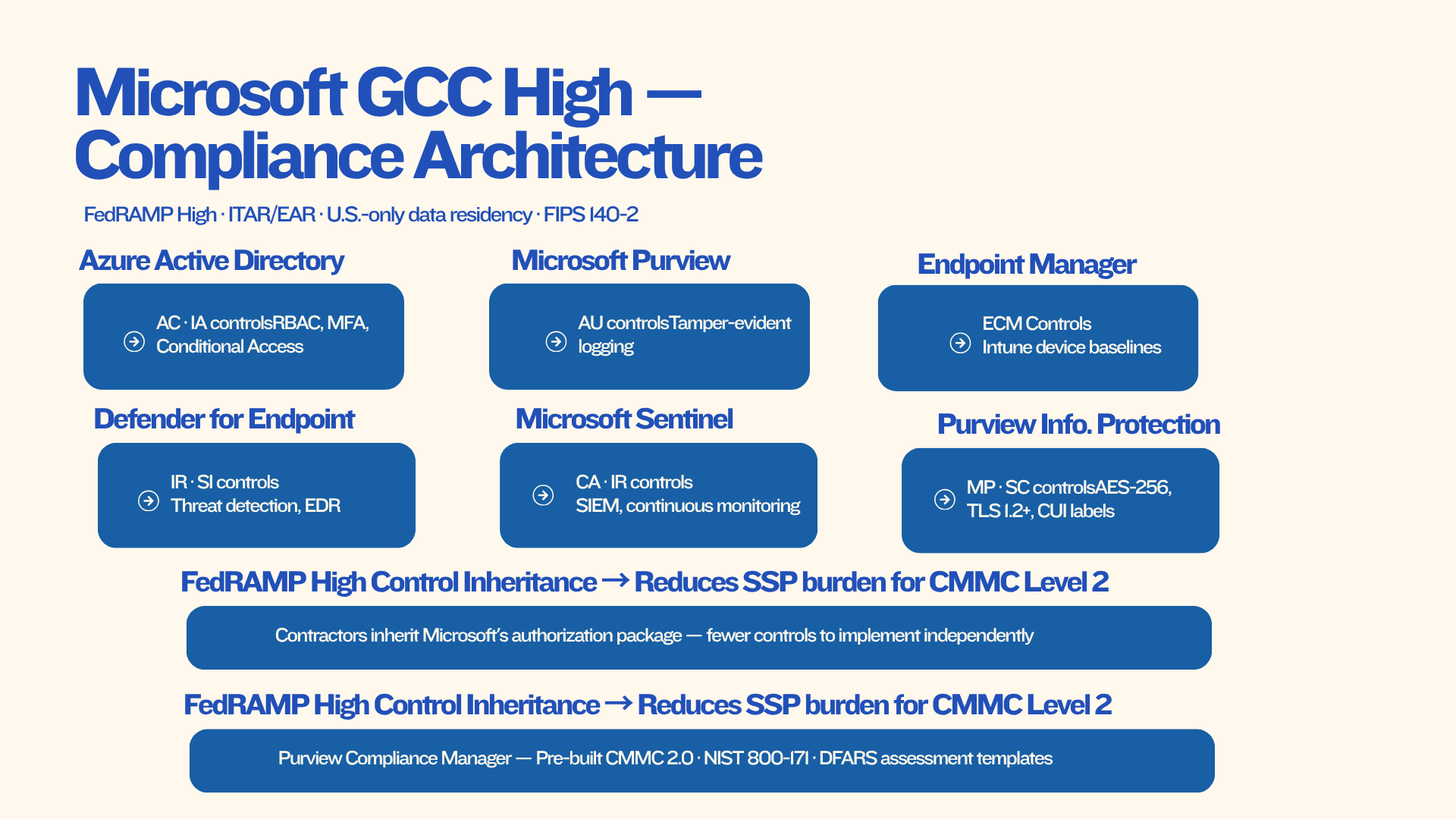
NIST SP 800-171 organizes its 110 security requirements into 14 control families. GCC High provides native, built-in capabilities that directly address the majority of these families.

As a 100% Microsoft-focused shop, ECF Data configures these native features to bridge your compliance gaps:

  • Access Control (AC): Azure Active Directory within GCC High enforces role-based access control (RBAC), multi-factor authentication (MFA), and Conditional Access policies—satisfying AC.1 through AC.22.
  • Audit and Accountability (AU): Microsoft Purview Audit within GCC High provides comprehensive, tamper-evident logging of user and administrator activities, supporting AU.2 through AU.9.
  • Configuration Management (CM): Microsoft Endpoint Manager and Intune within GCC High enable enforced device configuration baselines.
  • Identification and Authentication (IA): GCC High enforces FIPS 140-2 validated cryptographic modules for authentication, a specific CMMC Level 2 requirement.
  • Media Protection (MP): Data stored in GCC High is encrypted at rest using AES-256 and in transit using TLS 1.2 or higher—meeting MP.4 and MP.5.
  • System and Communications Protection (SC): GCC High’s network architecture includes isolated boundaries and meets SC.8 and SC.28 for data in transit and at rest protection.

The Microsoft SSPA (Supplier Security and Privacy Assurance) documentation confirms that GCC High services inherit FedRAMP High controls. This means your System Security Plan (SSP) can reference Microsoft’s own authorization package to satisfy a significant portion of your NIST 800-171 requirements.

Why Are Defense Contractors Moving to GCC High Before FY26?

The urgency around GCC High migration in 2026 stems from three converging factors: CMMC enforcement timelines, contract clause proliferation, and supply chain pressure.

  1. CMMC Phase-In Enforcement Is Active

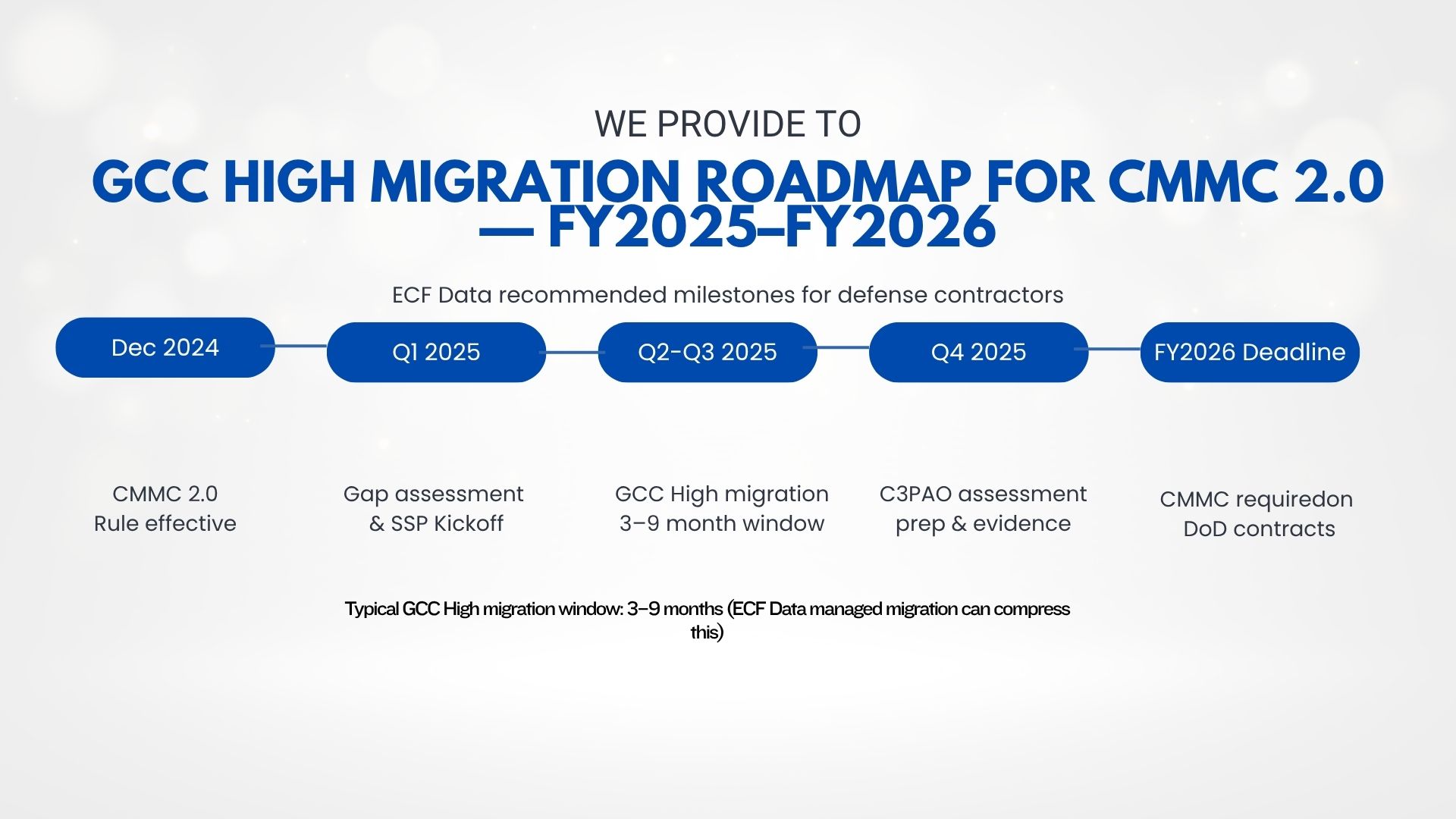
The DoD began including CMMC requirements in solicitations starting in FY2025 under the phased rollout outlined in the final CMMC 2.0 rule (32 CFR Part 170), which became effective December 16, 2024. By FY2026, a growing percentage of DoD contracts, including those at the subcontractor level, will require demonstrated CMMC Level 2 compliance. Contractors who have not completed their GCC High migration will face disqualification from new awards.

  1. Prime Contractors Are Mandating It

Large defense primes including Lockheed Martin, Raytheon, and General Dynamics have begun requiring their sub-tier suppliers to demonstrate CUI-compliant cloud environments as a condition of subcontract eligibility. GCC High is the de facto standard these primes recognize.

  1. Migration Takes Longer Than Expected

A full GCC High migration typically takes 3 to 9 months for mid-size defense contractors. Organizations that begin in early 2026 may still be in migration when critical solicitations close.

Can Commercial Microsoft 365 Support CMMC Level 2?

No—not reliably, and not safely. Commercial Microsoft 365 cannot reliably or safely support CMMC Level 2 compliance because it is a multi-tenant environment that CMMC Level 2 demands for CUI handling.

Commercial Microsoft 365 tenants are multi-tenant environments where data may be processed or stored by Microsoft personnel or systems outside US. This creates a direct conflict with ITAR, which prohibits the transfer of defense-related technical data to foreign nationals, even inadvertently through cloud infrastructure access.

Additionally, commercial Microsoft 365 does not enforce FIPS 140-2 validated encryption by default. It does not provide the tenant isolation required by DFARS 252.204-7012 and lacks the contractual commitments that document shared responsibility for CMMC-relevant controls. Attempting to achieve CMMC Level 2 compliance on commercial Microsoft 365 would require extensive compensating controls and custom configurations. Those are difficult to sustain and nearly impossible to audit cleanly.

What Compliance Advantages Does GCC High Provide?

GCC High offers concrete compliance advantages that reduce both assessment risk and long-term operational burden:

  • Inherited Controls: GCC High’s FedRAMP High authorization package allows contractors to inherit a significant number of controls for their SSP. It reduces the scope of what your organization must implement and document independently.
  • Data Residency Guarantees: Data is stored and processed exclusively in the U.S. by U.S. persons, contractually guaranteed via the Microsoft Government Customer Amendment.
  • Continuous Monitoring: Microsoft operates a continuous monitoring program within GCC High aligned to FedRAMP requirements. It provides a stream of security telemetry that supports your own monitoring obligations under NIST 800-171 CA.2 and CA.7.
  • Integrated Compliance Tools: Microsoft Purview Compliance Manager within GCC High provides pre-built assessment templates for CMMC, NIST 800-171, and DFARS.
  • Audit Logging Retention: GCC High provides audit log retention policies that align with federal requirements, a detail that frequently causes findings in assessments of commercial environments.

Is GCC High Necessary for Handling CUI?

For defense contractors, the answer is yes. Any organization that receives, generates, processes, stores, or transmits CUI in support of a DoD contract is required to protect that data using an environment that meets federal security standards. GCC High is the most straightforward way to achieve and demonstrate that protection within a Microsoft 365 ecosystem.

CUI is defined under Executive Order 13556 and the CUI Registry maintained by the National Archives. It encompasses categories such as Export Controlled technical data, Privacy Act information, and law enforcement sensitive information. All of which appear routinely in defense contractor workflows.

Using a non-compliant environment to handle CUI is not just an assessment risk. It is a potential violation of DFARS clauses that can trigger contract termination, suspension, and debarment proceedings.

What Is the Difference Between GCC and GCC High for CMMC?

Microsoft offers two government cloud tiers: GCC and GCC High. They are not interchangeable for CMMC purposes.
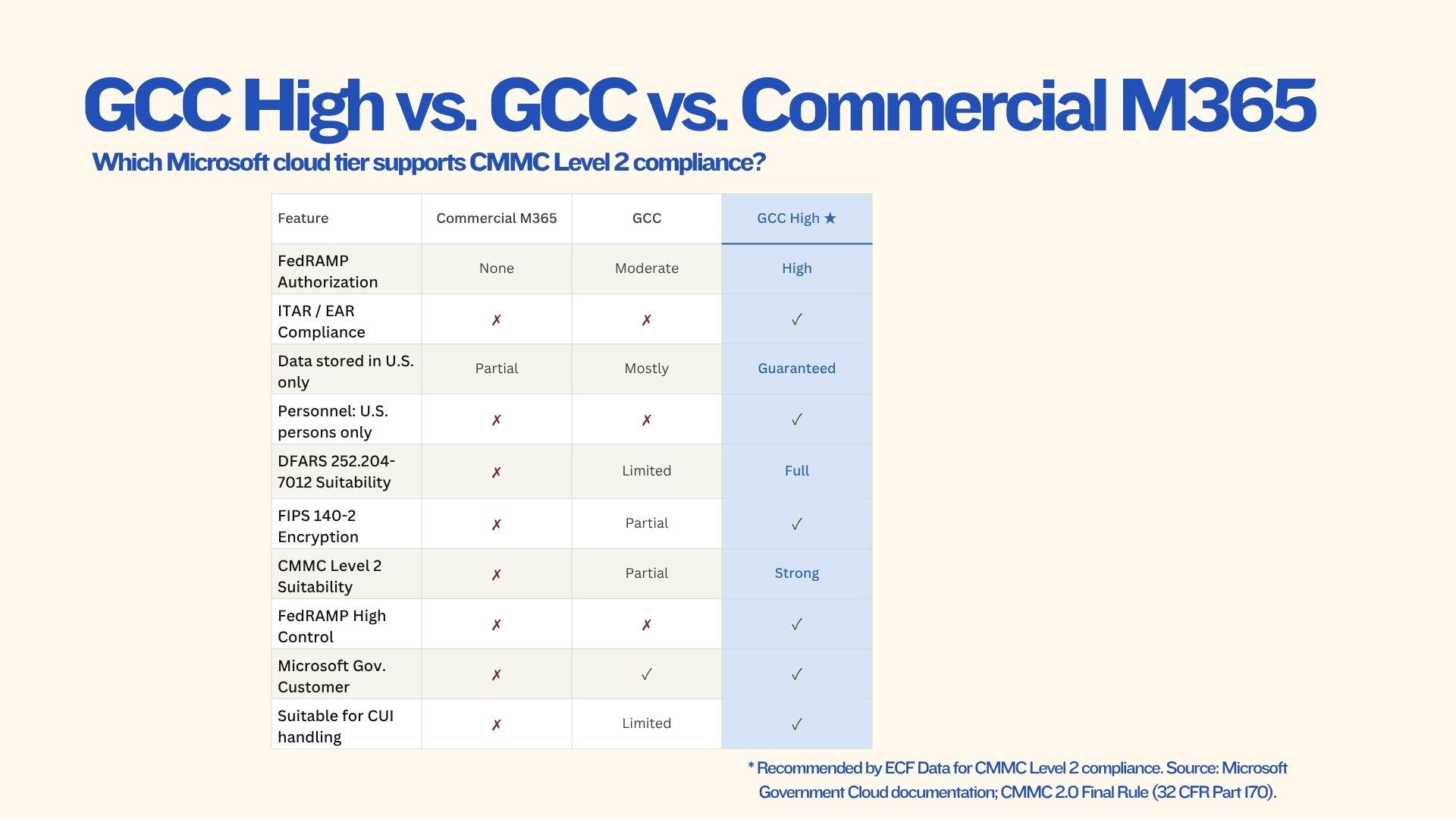
GCC is appropriate for state and local government workloads with moderate data sensitivity. GCC High is purpose-built for defense contractors handling CUI and ITAR-controlled technical data. For CMMC Level 2 compliance, GCC High is the correct tier.


How Does GCC High Support Audit Readiness?

CMMC Level 2 assessments, conducted by certified C3PAO (CMMC Third Party Assessment Organizations), require contractors to demonstrate that controls are implemented, documented, and operating effectively. GCC High supports this process in several concrete ways.

First, Microsoft provides a Customer Compliance Toolkit for GCC High that includes FedRAMP authorization packages, penetration test reports, and control implementation summaries. These documents form the evidentiary backbone of your SSP.

Second, the integrated tooling within GCC High, including Microsoft Defender for Endpoint, Microsoft Sentinel, and Purview Audit, generates the real-time logs and alerts that assessors request as evidence of operational controls. Rather than scrambling to produce 90-day log samples at assessment time, GCC High customers have centralized, searchable audit data available on demand.

Third, the tenant boundary of GCC High is itself a control artifact. Through the Microsoft admin portal, assessors can directly verify data residency, user access, and encryption configurations. This eliminates the need to rely strictly on written proof.

How ECF Data Accelerates GCC High Migration and CMMC Readiness

ECF Data is an authorized AOS-G partner specializing in the deployment and management of sovereign GCC High environments. Because Microsoft restricts GCC High licensing for organizations with under 500 users to a select group of AOS-G partners, ECF Data provides the exclusive procurement pathway and technical deployment small-to-midsize defense contractors need to remain compliant.

We turn raw cloud infrastructure into an audit-ready ecosystem using a three-phase approach:

  • Licensing & Eligibility: We manage the Microsoft Government Eligibility validation process, clearing onboarding hurdles like SAM.gov and CAGE code verification.
  • Sovereign Tenant Migration: Our engineers execute a secure tenant-to-tenant rebuild, safely moving identity structures, policies, and data from commercial environments into isolated Azure Government data centers.
  • Compliant Baseline Configuration: We pre-configure Microsoft Purview, Microsoft Entra ID, and Intune to directly bridge gaps across the 14 NIST SP 800-171 control families.

Leave a comment

Related Posts

Microsoft 365 GCC High Price Increase July 2026: A Complete Optimization Guide

The cost of maintaining a secure cloud environment is about to rise. Effective July 1, 2026, Microsoft is implementing...
Read More

CMMC Phase 2 Is Paused — What Actually Changes for Your GCC High and Microsoft 365 Environment

Outsourcing IT infrastructure is a concept that has been around for a while. Characterized in terms of technicians and engineers, workstations and servers, the idea of outsourcing IT needs...
Read More

How Much Does CMMC 2.0 Really Cost? A Level-by-Level Breakdown

Treating cybersecurity as an administrative afterthought is a severe business risk. Since the DFARS 252.204-7021 final rule finalized in late 2025 made certification an enforceable contractual requirement,..
Read More

Why Las Vegas Businesses are Dumping Reactive IT for 24/7 Managed Security in 2026

Outsourcing IT infrastructure is a concept that has been around for a while. Characterized in terms of technicians and engineers, workstations and servers, the idea of outsourcing IT needs...
Read More

GCC High Pricing in 2026: Why ‘Request a Quote’ Could Be Costing You Thousands

Outsourcing IT infrastructure is a concept that has been around for a while. Characterized in terms of technicians and engineers, workstations and servers, the idea of outsourcing IT needs...
Read More

Registration

Forgotten Password?