-
 By: Janina Criador
 - IT Management
- Last Updated On: June 19, 2026
- Comments 0
- ⏱️8 min read

How Much Does CMMC 2.0 Really Cost? A Level-by-Level Breakdown
Treating cybersecurity as an administrative afterthought is a severe business risk. Since the DFARS 252.204-7021 final rule finalized in late 2025 made certification an enforceable contractual requirement, defense suppliers are no longer asking if they need it, but how much it will realistically cost.
When contractors ask ECF Data about CMMC Compliance costs, they want a simple number. But reality is far more nuanced. CMMC Level 2 certification—the mandatory tier for handling Controlled Unclassified Information (CUI)—typically costs $75,000 to $300,000 upfront, with $30,000 to $90,000 in annual maintenance.
The biggest budgeting mistake we see is assuming the assessment fee is the primary expense. For teams migrating to a Microsoft Government Cloud like GCC or Microsoft GCC High, total investments can climb well past $500,000 depending on user count and scope.
This guide breaks down the true cost of CMMC 2.0, exposes the hidden cost in CMMC, and outlines how ECF Data’s cloud architecture strategies optimize your budget.



Understanding CMMC 2.0 as an Enforceable Requirement
What is CMMC 2.0?
CMMC 2.0 is the Department of Defense’s (DoD) mandatory cybersecurity framework for contractors and subcontractors within the defense industrial base (DIB). The framework establishes security requirements designed to protect Federal Contract Information (FCI) and Controlled Unclassified Information (CUI).
Who Must Comply?
Any organization bidding on or performing work for the DoD must achieve the appropriate CMMC level based on the sensitivity of the data they handle. Organizations that fail to achieve certification will be disqualified from future contract opportunities.
Why Did the DoD Implement CMMC?
The DoD introduced CMMC to address growing cybersecurity weaknesses across the defense supply chain. Rather than relying solely on self-attestation, the government now requires measurable proof that contractors can adequately secure sensitive information against cyber threats and nation-state supply chain attacks.
The Three Phases of CMMC Compliance Costs
At ECF Data, the biggest misconception we encounter is that compliance is a one-time audit expense. Costs span three distinct phases over a multi-year lifecycle.
Phase 1: Readiness & Remediation (Where ECF Data Steps In)
- Timeline: 3–6 months before assessment
- Typical Cost: $25,000–$170,000+
Consuming most first-year spending, this phase becomes expensive because organizations underestimate the operational effort required to configure systems, formalize security processes, and participate in mock assessments.
Phase 2: The C3PAO Assessment
- Timeline: Multi-week engagement
- Typical Cost: $35,000–$75,000
- This formal third-party certification audit does not include remediation work. If you fail, additional consulting and re-audit expenses will quickly escalate your costs.
Phase 3: Ongoing Compliance Maintenance
- Timeline: Continuous
- Typical Cost: $30,000–$90,000 annually
- Achieving certification is only the beginning. Organizations that treat compliance as a “check-the-box” exercise often struggle during renewal cycles because they fail to maintain controls year-round. ECF Data provides ongoing managed compliance support to ensure you stay audit-ready 365 days a year.
CMMC 2.0 Cost Breakdown by Level
Level 1: Foundational Security
Level 1 applies to organizations handling FCI. Requirements focus on 17 basic cyber hygiene practices such as antivirus deployment, password policies, and firewall protection. Because it relies on an annual self-assessment, organizations avoid third-party audit fees entirely. Most Level 1 organizations spend $5,000–$10,000 primarily on basic tooling and minor consulting support.
Level 2: The Core Defense Contractor Tier
CMMC Level 2 represents the majority of defense suppliers. Organizations must implement all 110 controls from NIST SP 800-171 and pass a third-party assessment every three years.
Based on historical data from projects managed by ECF Data, the baseline cost components generally shake out as follows:
- Gap Analysis & Scoping
- Infrastructure Remediation
- Policy & Documentation Development
- C3PAO Audit Fees
- Annual Maintenance
The biggest driver of cost variability here is the condition of your existing environment. Organizations with legacy systems, weak identity controls, or poor documentation spend substantially more.
Level 3: Advanced National Security Protection
Level 3 is designed for contractors supporting highly sensitive defense programs. Requirements extend beyond Level 2 and incorporate advanced protections from NIST SP 800-172 to defend against sophisticated Advanced Persistent Threats (APTs). Costs routinely exceed $500,000 because organizations require dedicated Security Operations Centers (SOCs), advanced threat hunting, air-gapped systems, and specialized cleared personnel. These assessments are conducted directly by government auditors through DIBCAC.
Why Are Assessment Fees Only One Part of CMMC Costs?
True visibility into CMMC costs means recognizing that assessment fees are a red herring. While many small to mid-sized contractors budget $15,000–$30,000 for the audit thinking they are covered, official C3PAO fees account for only 5% to 15% of total first-year costs. The remaining 85% to 95% is swallowed by building and maintaining the actual security architecture.
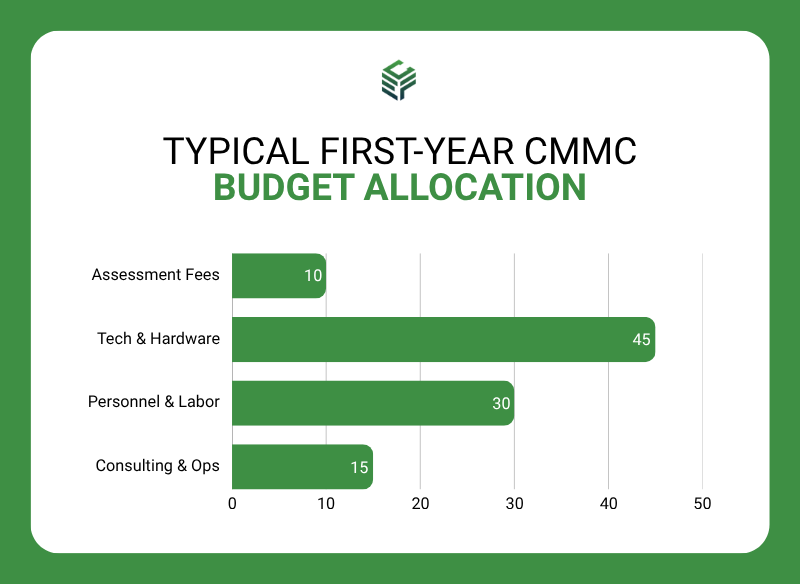
- Technology Investments (Hardware, Software, Licenses): 40–50% of total costs.
- Personnel and Staffing (Internal labor, Security Analysts): 25–35% of total costs.
- Consulting and Professional Services (Gap analysis, SSP writing): 10–20% of total costs.
- Ongoing Monitoring and Maintenance: 10–15% of total costs.
For example, a $20,000 audit fee for a mid-size company usually translates to a total first-year CMMC investment of $150,000 to $300,000.
How Much Will Your Organization Actually Invest Infrastructure?
If you have been operating without formal security controls, building the required infrastructure is expensive.
- Network Segmentation: Costs $50,000–$200,000+ to isolate sensitive systems and rebuild network architecture.
- Endpoint Protection & Response (EDR): Runs $100–$500 per device annually. For 100 devices, that’s $10,000–$50,000 per year.
- Identity & Access Management (IAM): MFA, Active Directory enhancements, and privileged access management cost $20,000–$100,000+ in setup plus recurring licenses.
- SIEM & Continuous Monitoring: Security information and event management tools cost $2,000–$10,000/month, plus the cost of a security analyst or SOC support ($80,000–$150,000+ annually) to manage it.
Hidden Cost in CMMC Most People Miss
Several quiet cost multipliers will impact your bottom line.
Documentation Overload
CMMC evaluates whether controls are institutionalized through written policies. Developing System Security Plans (SSPs), incident response procedures, and evidence libraries costs $12,000–$70,000. Generic templates often fail to audit scrutiny, forcing expensive rewrites.
Internal Labor Diversion
Forcing your internal IT team to map data flows, configure logging, and compile audit evidence creates an operational bottleneck. For mid-sized contractors, this opportunity of cost and productivity loss routinely exceeds $40,000–$80,000.
MSP & Vendor Realignment
Traditional MSPs often lack the certifications or infrastructure required to support a CMMC Level 2 environment. Upgrading your provider to a Managed Regulatory Service Provider (MRSP) commonly increases annual IT spending by 50–150%.
Third-Party Supply Chain Risk
If your contract relies on subcontractors, you may need to audit and monitor their security posture, compounding compliance management costs across your vendor network.
Compliance Management Software
Tools to track policies and manage audit evidence cost $3,000–$15,000 annually.
Legal, Insurance, and Downtime
Updating contracts requires legal reviews ($5,000–$20,000). System hardening downtime impacts daily operations, and cyber liability insurance add-ons add another $1,000–$5,000 annually.
What Role Does Microsoft GCC High Play in Your CMMC Costs?
For contractors handling CUI, cloud architecture decisions heavily dictate compliance complexity and long-term spending. Moving to Microsoft Government Cloud does not automatically guarantee compliance, but it fundamentally redefines your total cost structure.
1. Microsoft 365 Commercial
Commercial M365 can technically support many Level 2 controls. But it creates immense legal and operational risk because Microsoft does not fully support DFARS reporting obligations in its standard commercial environment. This option is generally best suited for Level 1 organizations handling only FCI.
2. Microsoft GCC
Microsoft GCC provides stronger compliance, featuring U.S. data residency, DFARS support, and FedRAMP-aligned infrastructure. While licensing costs 15–20% more than commercial M365, GCC offers the most balanced option between cost and compliance for handling standard CUI.
3. Microsoft GCC High
GCC High is the gold standard for organizations handling ITAR (International Traffic in Arms Regulations), EAR (Export Administration Regulations), or highly sensitive defense data. It operates on an isolated infrastructure restricted to vetted U.S. personnel.
However, the financial impact of moving to GCC High is substantial:
- License Premiums: GCC High typically costs 40–100% more than commercial equivalents. For example, an E3 license sits around $39/user/month, whereas the GCC High equivalent with security add-ons can soar to $84+/user/month. For a 50-user organization, this is an immediate $25,000 annual increase.
- Tenant Migration Costs: GCC High migration requires a completely new tenant creation, secure data extraction, environment rebuilding, and reconfiguration. It costs $15,000–$50,000+, and significantly more for complex environments.
- Feature Lag: Because features undergo intensive federal vetting, GCC High functionality often trails commercial M365 by several months, requiring modified workflows and extra user training.
How Can You Optimize Your CMMC Budget?
The Secure Enclave Strategy
The single most effective way to reduce CMMC costs is to narrow your scoping. Instead of migrating your entire business to GCC High, isolate only the employees who touch CUI. This strategy narrows your audit scope, reduces license overhead, and slashes overall compliance spending by 40% to 55%.
Conduct a Pre-Assessment Gap Analysis
Spending $5,000–$10,000 on a thorough gap analysis before committing remediation will save you $50,000+ in unnecessary hardware or software investments.
Leverage Managed Regulatory Service Providers (MRSPs)
For smaller contractors, outsourcing your security monitoring and compliance framework to a specialized MRSP is significantly cheaper than attempting to hire full-time, in-house cybersecurity analysts and building out custom SOC infrastructure from scratch.
Conclusion: Compliance as a Competitive Advantage
There is no denying that CMMC compliance is expensive. But organizations that treat it solely as a regulatory risk burden that they are missing the larger strategic picture. As CMMC enforcement accelerates through DoD contracts, uncertified contractors will increasingly find themselves locked out of the market.
By partnering with ECF Data early, you invest in secure infrastructure, documented governance, compliant cloud environments, and continuous monitoring that build long-term competitive advantages. The real question is no longer, “How much does CMMC cost?” It is, “How much revenue will we lose if we remain uncertified?”
In defense contracting, compliance isn’t just a requirement—it’s your ticket to the market. Partner with ECF Data to streamline your compliance journey and secure your competitive edge.