-
 By: Janina Criador
- IT Management
- Last Updated On: February 1, 2026
- Comments 0
- ⏱️8 min read

Who Is Eligible for GCC High? Requirements, Documentation & Approval Timeline
Key Takeaway Box:
Microsoft 365 GCC High is a secure cloud built for U.S. government agencies and defense contractors. To qualify, your organization must prove it handles sensitive federal data or supports a critical government mission.
- Who Qualifies: U.S. government entities and “Category 3” companies handling CUI, ITAR, or EAR data.
- Key Requirements: You must provide a valid CAGE code or SAM.gov registration and a signed government contract or sponsor letter.
- Approval Time: The validation process typically takes 3 to 4 weeks through an authorized AOS-G partner.
Securing DoD contracts starts with the right cloud. If you want to stay compliant and win bids, your cloud environment must meet federal standards. Microsoft 365 GCC High is the gold standard for organizations that must safeguard sensitive data like Controlled Unclassified Information (CUI) and International Traffic in Arms Regulations (ITAR) data. But who is actually eligible?
Only three groups can sign up for GCC High. These are U.S. government agencies and “Category 3” companies. These companies are usually defense contractors or aerospace builders.
Microsoft checks every applicant very carefully. They do this because GCC High is separate from the regular internet.
It is run only by U.S. citizens who have passed background checks.
This guide will show you exactly how to get approved. We will cover:
- Essential documents you need
- Definitive breakdown of eligibility requirements
- Realistic step-by-step timeline for approval
Whether you are a large prime contractor or a small shop, this roadmap will help you get validated.
What Is GCC High?
GCC High is a special version of Microsoft’s military cloud. It was built for two groups: government agencies and private companies that work for them.
Think of it as a private island. It is kept separate from the regular “Commercial” cloud used by most businesses. It sits on a secure platform called Azure Government.
Why do companies use it? It is built to meet strict U.S. laws. It protects high-level secrets like technical data for weapons or flight parts (ITAR). By 2026, almost any company handling sensitive defense data (CUI) must use GCC High to pass their security audits.
Who Is Eligible for GCC High?
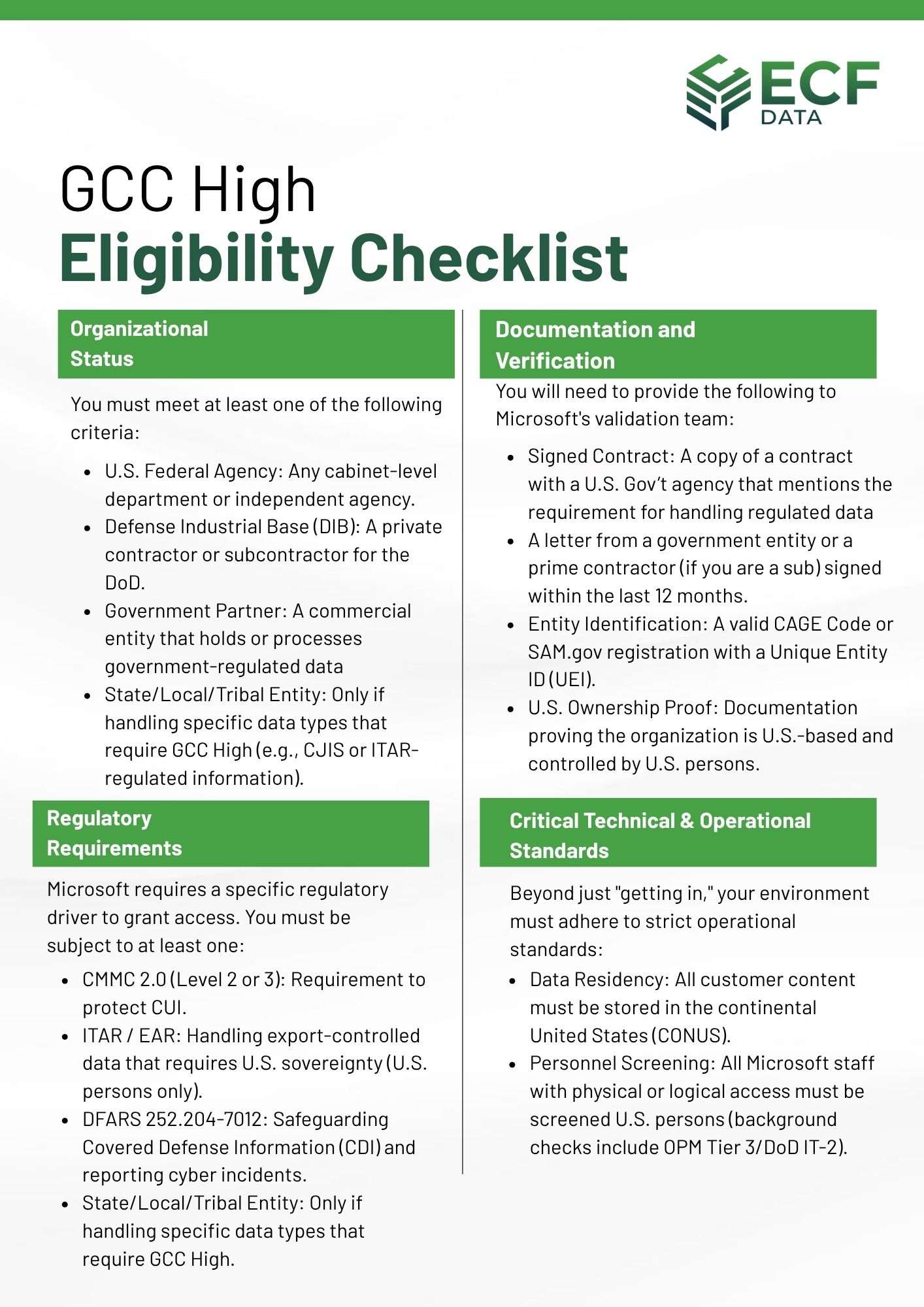
GCC High eligibility is a legal qualification. To qualify, your organization must fall into one of the following regulated categories. Each entity is further discussed below:- U.S. Government Entities
- Defense Contractors and Government Partners
- Critical Infrastructure and Regulated Industries
1. US Government Entities- Federal, State, and Local Government
All U.S. government agencies can qualify. This includes federal, state, local, tribal, and territorial agencies. Most local governments use standard GCC. However, agencies that handle very sensitive criminal justice or federal data may need GCC High.2. Defense Contractors and Partners
Most private companies that qualify fall into this group. You may be eligible if you:- Handle ITAR or EAR data
- Works on DoD contracts with CUI
- Is a cleared facility
3. Critical Infrastructure and Regulated Industries
Certain businesses in energy, aerospace, and pharmaceuticals may also qualify. This applies if they support government missions and must meet FedRAMP High or NIST 800-171 requirements.Who Is NOT Eligible?
You will likely be turned down if:
- You are a Non-U.S. Entity: GCC High is strictly for U.S.-based organizations with U.S. persons. International subsidiaries usually cannot join the same tenant.
- You Only Handle “Public” Government Data: If your data is not CUI, ITAR, or EAR, Microsoft will direct you to the standard GCC or Commercial cloud.
- You Are a “Category 2” Entity: While Category 2 (commercial entities with government-sponsored data) can access Azure Government, they are often restricted from the M365 GCC High productivity suite. Unless they can prove a specific regulatory mandate (like ITAR).
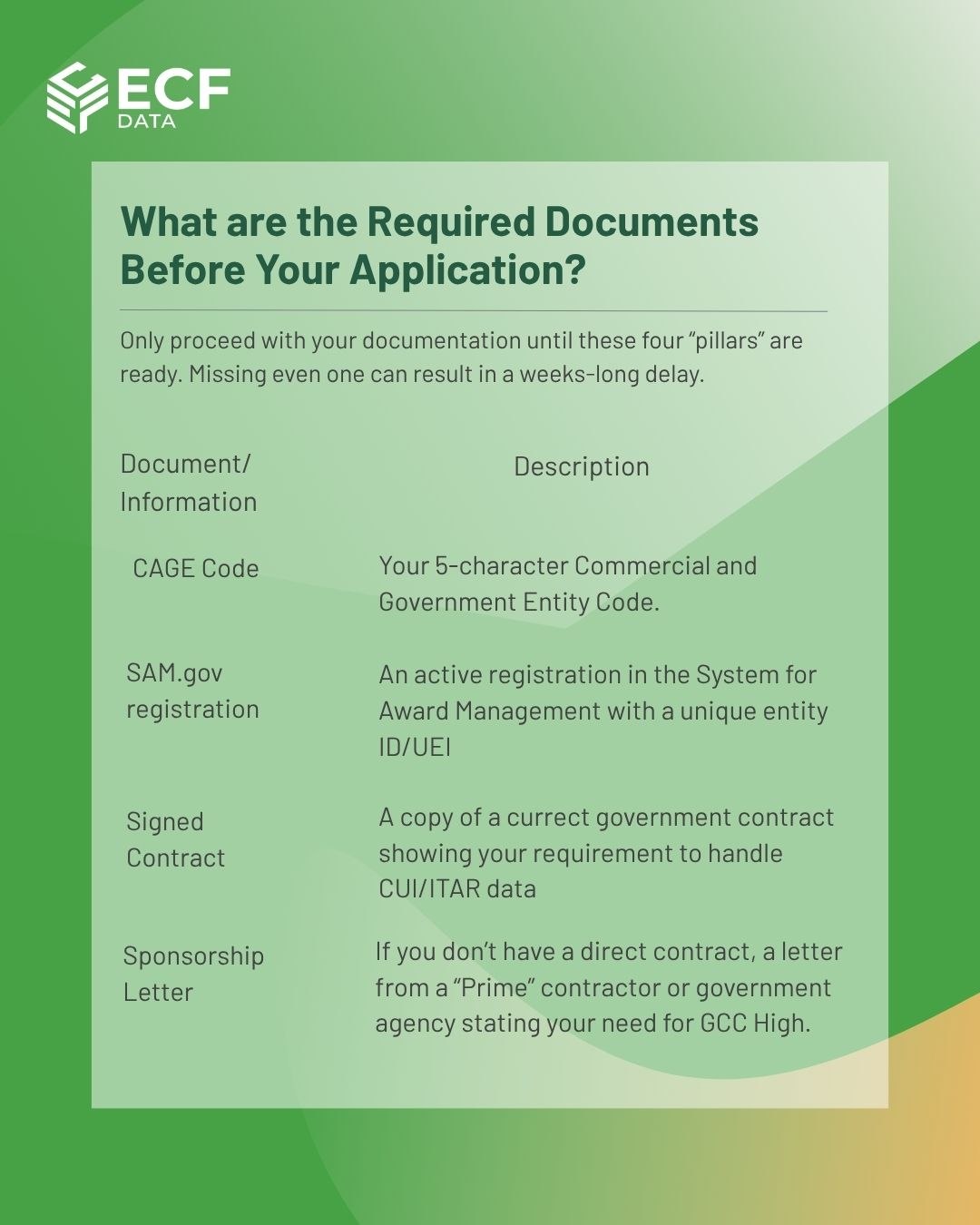
What are the Required Documents Before Your Application?
Microsoft GCC High Approval Process: Step-by-Step
The approval process is handled by the Microsoft Government Cloud Eligibility Team. It is an online validation, not a simple “buy now” checkout.
Step 1: Submit the Eligibility Intake Form
Visit the Microsoft US Government Cloud Eligibility Request page. You must select “Customers handling government-controlled data” (Category 3).
Note: Do not select “Solution Provider” unless you are a licensed reseller. Doing so will lead to automatic rejection.
Step 2: Verification of Legal Status
Microsoft will cross-reference your UEI and CAGE code with government databases. They are looking for a match in your legal business name, address, and “active” status.
Step 3: Submission of Proof (The Evidence Phase)
You will receive an email from the Microsoft Eligibility Team. It is typically sent within 2-3 business days) requesting your contract or sponsorship letter. You must provide a document that explicitly mentions NIST 800-171, DFARS 7012, ITAR, or CMMC.
Step 4: Final Validation and Approval
Once the documentation is verified, you will receive a Validation Email. This email acts like your “golden ticket.” You cannot purchase licenses without forwarding this specific confirmation to an authorized AOS-G partner.
Note: There are fewer than 100 authorized AOS-G partners globally (such as ECF Data) that can license GCC High for organizations with under 500 seats.
How Long Does GCC High Approval Take?
In 2026, the timeline has stabilized, but it is still far from “instant.”
- Initial Request Response: 2–5 Business Days for Microsoft to check your information.
- Documentation Review: 5–10 Business Days (highly dependent on your response speed).
- Final Approval & Validation ID: 2–3 Business Days.
- Total Expected Timeline: 3 to 4 weeks.
Crucial Note: This timeline only covers eligibility. Provisioning the tenant and migrating your data can take an additional 3 to 6 months depending on the size of your organization.
Common Reasons GCC High Requests Get Rejected
Knowing these common pitfalls can save you from delaying your validation process and compliance.
- Mismatched Addresses: The address on your Microsoft Commercial tenant (if you have one) must exactly match your SAM.gov/CAGE code address.
- Incomplete Contracts: Providing a “Letter of Intent” instead of a signed contract or an official sponsorship letter on government letterhead.
- Wrong Eligibility Category: Choosing Category 2 (which only grants access to Azure Government) when you actually need Category 3 (which grants M365 GCC High).
- Expired SAM Registration: If your UEI status is “Expired” or “Pending Renewal,” Microsoft will pause your application immediately.
- Vague Justification Section: Simply putting the word compliance in the justification can flag it as insufficient. You must give a clear report on the type of government data you use. You also need to show which federal rules you are following.
Why GCC High Matters for CMMC 2.0 Compliance
In late 2025, the government started enforcing new rules called CMMC 2.0. If your company handles sensitive defense data (called CUI), you must now follow 110 specific security steps.
While you could try to meet these rules using a standard cloud, it is much harder. This is because Microsoft does not provide a “Shared Responsibility Matrix” for its basic services.
Think of it like a “Division of Labor” list: A Shared Responsibility Matrix is a document that clearly shows which security tasks Microsoft handles for you and which ones you must handle yourself. Without this list, you may have to prove every single security step to an auditor on your own, which is very difficult and expensive.
GCC High is the easiest path to success. It gives you the solid foundation you need to pass an audit and keep your government contracts.
Summary: Is GCC High Right for You?
If you handle CUI, ITAR, or DFARS 7012 data, guessing should not be an option.
ECF Data is an authorized AOS-G partner that helps defense contractors navigate Microsoft’s GCC High eligibility validation, documentation, and CMMC-aligned migration.
Download the GCC High Eligibility Checklist and determine with clarity whether your organization qualifies before you submit to Microsoft.
Frequently Asked Questions
1. Which GCC High licenses are the most common?
There are three main options depending on your company size and security needs:
- Microsoft 365 Business Premium (GCC High): Best for small to mid-sized contractors (up to 300 users). It is the most cost-effective way to get the security you need.
- Microsoft 365 G3 (GCC High): The “standard” choice for most companies. It includes full Office apps and the security tools required for CMMC Level 2.
- Microsoft 365 G5 (GCC High): The top tier option. It includes advanced automation, identity protection, and “all-in-one” compliance tools.
2. Does GCC High automatically make CMMC compliant?
No. Think of GCC High as a “compliant-ready” house. Microsoft provides the secure foundation, walls, and roof, but you are responsible for how you live inside it. To pass an audit, you must still:
- Set up your security settings (configurations) correctly.
- Write down your rules and processes (documentation).
- Regularly check your systems for threats (monitoring).
3. Can we change or adjust our licenses later?
Yes. While most GCC High licenses require a one-year commitment, you can usually add more seats or upgrade your plan during your contract. It is best to work with your AOS-G partner (like ECF Data) to adjust your licenses during your “renewal window” to avoid extra fees.
Why is GCC High more expensive than the regular cloud?
GCC High costs more because it is a “sovereign cloud.” This means the data centers are located only in the U.S., and the staff who manage the servers are U.S. citizens who have passed rigorous background checks. You are paying for a higher level of privacy and physical security. Get a clear look at licensing tiers and migration fees before you sign a contract.